


These plants are called Maximilian Sunflowers (Helianthus). It is a perennial sunflower with numerous blooms. The blooms grow up to 5 inches. Five inches is usually smaller than many sunflowers that have only one or two blooms on the plant.


Note: Perennial vs. Annual– A Perennial plant reappears each year for several years sending up new growth each year from the portions of the plant that survived the winter or non-growing season. An Annual is a plant that completes its life cycle in one growing season. In an annual, the seed is usually the only portion of the plant that survives to start the new life cycle.
Watch the video below. Note that there are two bugs on this flower, an Eastern Bumble Bee (Bambi’s Impatiens from the family Apidae) and a small beetle. All insects are invertebrates with six legs, an exoskeleton, three body segments, compound eyes, and a single pair of antennae. Look at the similarities of these two insects in the video below.*
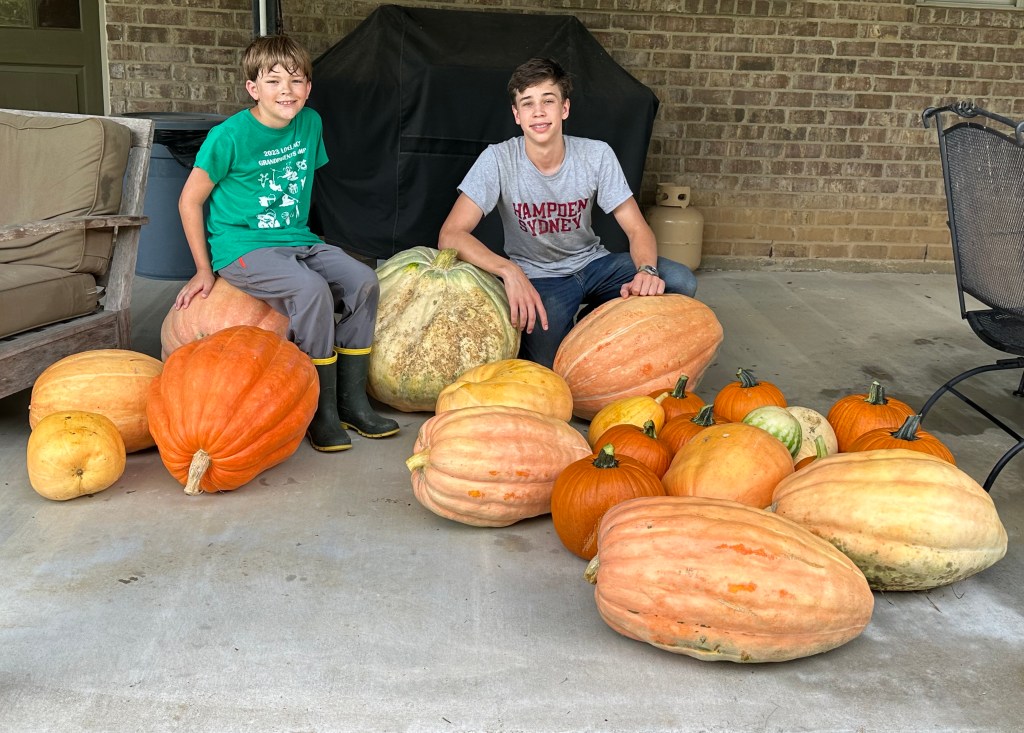
Below: Very Little Pumpkins- Not every pumpkin reaches its full potential in size before it ripens. The two pumpkins below are very small, and yet they are both ready for harvest. The orange color and the stem tell us that these pumpkins will not get any larger and are ready for harvest. Look at the vines of the pumpkin plant in picture 5 and the video below. Notice the spines on the stems are similar to the spines on the poisonous nettle plant in the previous blog. However, these spines do not release a toxin and the only harm they cause is the slight pricking sensation as one handles these vines.


The insect (dragonfly or Easter Pondhawk in the family Libellulidae) above and below has a lot in common with the bee and the beetle (or it would not be an insect). There are over 3000 species of dragonflies. See if you can find all of the insect characteristics listed above on this dragonfly.
Science Tip: Let’s examine some of the terms used in describing insects.
Invertebrates: This category means it has no spine or column of bones down its back. (Goats, snakes, frogs, birds, alligators, and humans are all vertebrates having a column of bones down the body.)
Exoskeleton: Hard or rigid outer covering of the body. (Crabs and crawfish also have exoskeletons, while humans, goats, birds, frogs, and alligators have endoskeletons or bones on the inside that support the soft tissue of the body).
Three Body segments: Head, Thorax, Abdomen appear to be separate parts. Although humans and many other animals have a head (brain), a thorax (lung area), and an abdomen (stomach or digestive area), insects have these areas in segments.
Compound Eyes: Compound means essentially multiple eyes in each of the two large eyes. Actually a compound eye has tiny independent photoreceptor units. Each unit consists of a cornea (covering) lens (to focus), and photoreceptor cells (pick up light). These units can distinguish brightness and color. Each of our human eyes has only one cornea and one lens. Humans do not have compound eyes.
Antennae: (also called feelers) are paired appendages that are segmented (one or more jointed segments) and used for sensing. Humans definitely do not have antennae.
All three of the insects shown above have wings. However, not all insects have wings. (Do you remember the wingless velvet ant which was really a wasp in a previous blog? It was an insect, but the female of the species has no wings.)
If you like this blog, let us know and please tell your friends. You can also write to us with your questions at anytime.