



I finally learned to combine the videos on Mexican Free-tail bats. Bats are the fastest animals on earth (up to 99 mph). Bats have the amazing ability to turn on a dime in mid flight. The average bat flys 375 miles per night while searching for food. There are more than 900 species of bats and over half use sound echo (sonar) to locate the insects they eat and to avoid objects. Bats can see, but use this echolocation (sonar) since most of their flying is done between dusk and dawn. Most bats emit sounds that are beyond the range of the human ear. If we could hear this sound, it would seem quite loud. The ears and brain cells of a bat are especially tuned to the frequency of their sound and the echo that results from their sounds. Bats can locate objects the size of a human hair with this echo system. Each time you see a bat change course, the bat has located dinner in the form of a bug. After the bat emits the sound, the ear must change to hear the echo. The actual mechanism of the ear preparing for the echo takes 6 ms (milliseconds) or six one thousands of a second. Last, but not least, bats are in the Kingdom of Animalia and the Class Mammalian (produces milk, has hair, had 3 middle ear bones). Bats also love the heat. Watch a minute or two of the video below and see this amazing animal at work.
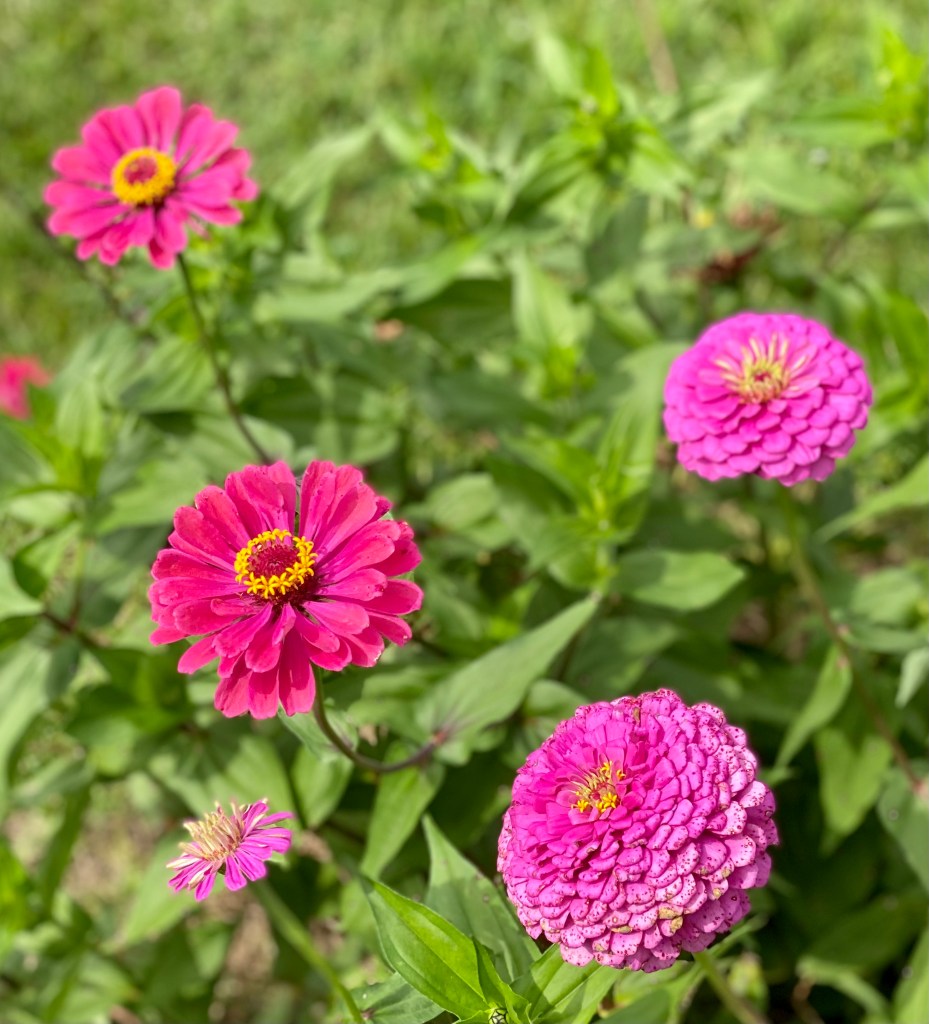
Below: Too much of a good thing is not always good. We have discussed that flowering plants get pollinated, produce a fruit or seed pod, and then the seeds germinate to start the process over again. Slide #1 and 2 below show a Zinnia bed fourteen days after the plants were pulled up. Many of the flowers had already dropped their seeds and the abundance of small zinnia plants are the result. However, each plant needs about 8-10 inches or more to grow into a healthy bush. We transplanted many of these plants to other areas to give them a chance to mature into a healthy bush. If left close together, they will be spindly and eventually develop mold on the leaves. Slides 3-10 show the plants after transplanting. The temperature is close to 100 degrees F, so the weather is not ideal for transplanting. However, in a day or two, all of these drooping plants will stand upright and put down additional roots as they adapt to their new location.


Below: We previously wrote about our on-going battle to remove the rust from the water. We have a three-part filtration system and recently changed the medium in the large tank to start removing particles that were the size of 3 microns. The large tank does a backwash (reverses the water flow) once a day to empty the iron that has been caught by the filter medium. Unfortunately the iron is still winning. Below is a picture of the second filter in the system after the large tank filter. The second pictures show the new filters. The 3rd picture is the previously white filter after ten minutes of water flow. This white filter already has iron particles visible. Rust discolors clothing, but is not unsafe. If this were dissolved iron, we could use a chemical reaction to bind the iron and remove the iron. However, rust is actually a particle formed by oxidized iron (a chemical reaction). This oxidized particle is not in solution and the only way to remove rust is to use filtration. Pictures below are before changing the filters, immediately after changing the filters, and ten minutes after changing the filters.


Below: The video shows the rust (iron oxide or iron that has combined with oxygen) that gets caught on the filter in our water system. The coating of rust is so thick, that it physically slows the water flow (drops the water pressure) in the house.
Science Tip: What is a solution? Solutions are composed of a material (solute) being dissolved in a solvent. The mixture becomes homogeneous as the molecules of the solute go in between the molecules of the solvent and are evenly dispersed. The solute cannot be filtered out after going into solution. For example, if you stir sugar into water, you will first see the granules of sugar, then the mixture becomes cloudy, then the mixture is clear like the water was before you added the sugar. The sugar (solute) is in solution in the water (solvent). To redeem your sugar, you would have to evaporate the water (because the water would become a vapor at a temperature of 212 degrees F.). Dissolving sugar in water is a physical change, not a chemical change. If instead, you stirred sand into the water, the sand particles would not go in between the water molecules. The sand could be separated from the water by filtering the water through a piece of cloth. The molecules of the sand never went in between the water molecules and thus the sand never went into solution like the sugar went into solution. Rust in the water is like the sand in the water. Unfortunately, we have to change our filters often because there is so much rust that it blocks the water flow through the filters.